What the preamplifier matching achieves in practice
1. The main message
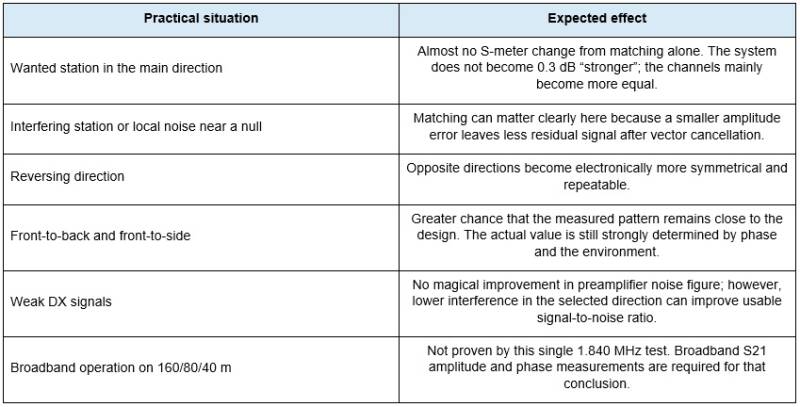
Preamplifier matching does not suddenly make received signals noticeably stronger. All nine units already had approximately the same gain. What matching does achieve is to ensure that the electronic channels disturb the intended amplitude weighting and phase combination of the RX9 array as little as possible. The main benefit is a cleaner and more symmetrical pattern, more repeatable directions, and a greater chance of deep rejection of unwanted signals and local noise.
Important: the benefit is therefore not extra dB for the wanted station, but preservation of the array behaviour.
2. What does the measured spread mean as an ordinary signal-level difference?
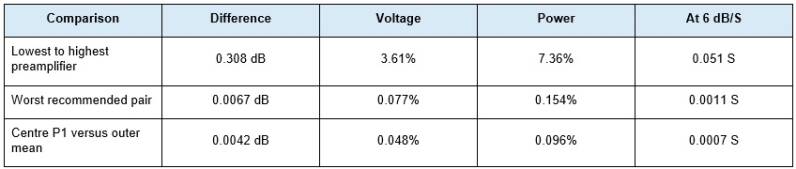
The full 0.308 dB spread may look large in a table, but in ordinary receiving terms it is very small: about 3.61% in voltage, 7.36% in power, and only 0.051 of one S-unit when 6 dB per S-unit is assumed. It is not audible as an individual level difference. The optimum pair mismatch of 0.0067 dB is effectively zero.
3. Why such a small difference still matters in an array
A directional array works by adding and subtracting signals as vectors. In the wanted direction, the contributions must add with the intended phase and amplitude. In a rejected direction, selected contributions must nearly cancel. A level difference that is inaudible on a receiver can still leave a measurable residual during cancellation.
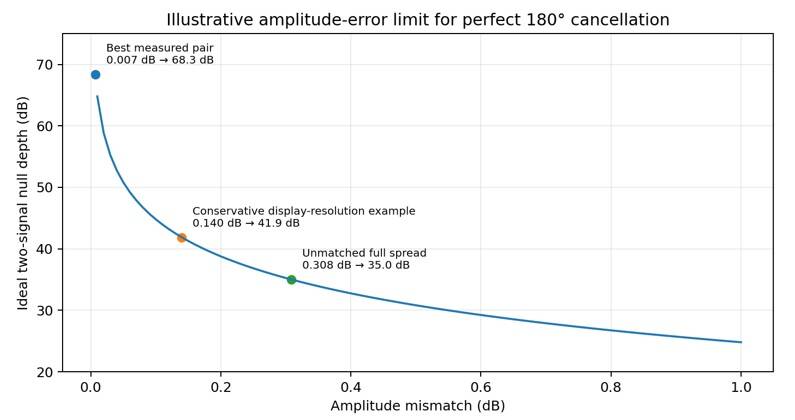
For two signals with perfect 180° opposition but an amplitude ratio r, the theoretical null depth relative to their in-phase sum is:
Null depth = 20 log₁₀((1 + r) / |1 − r|)
4. What the selected matching specifically achieves
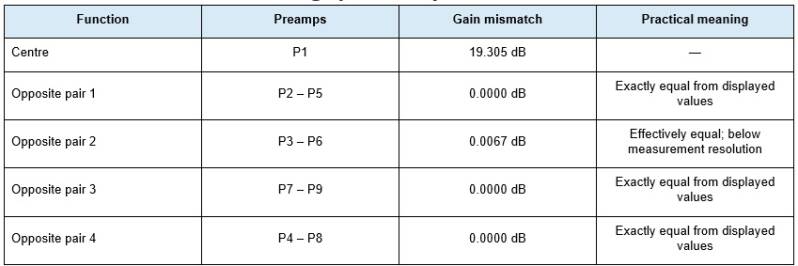
- When switching to the opposite direction, the array receives virtually the same electronic gain on both sides of each axis.
- The intended amplitude ratios of the combiner are not measurably distorted by preamplifier-to-preamplifier differences.
- Centre preamplifier P1 is only 0.0042 dB from the mean of the eight outer units, approximately 0.048% in voltage.
- Preamplifier gain is therefore very unlikely to be the factor that limits the final front-to-back ratio or null depth.
- Any practical difference later observed between directions should be sought first in the antenna elements, soil, mutual coupling, coax phase, relay/combiner network, local noise source, or changing signal arrival angle.
5. What you will and will not notice in the real world
6. Why phase will probably become the practical limitation first
The amplitude matching is now so good that relatively small phase errors are more likely to limit the null. With two exactly equal signals, a residual phase error around the intended 180° cancellation theoretically gives the following limits:
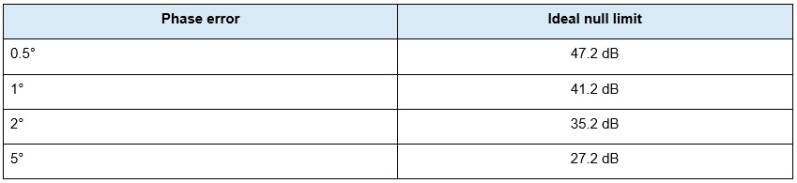
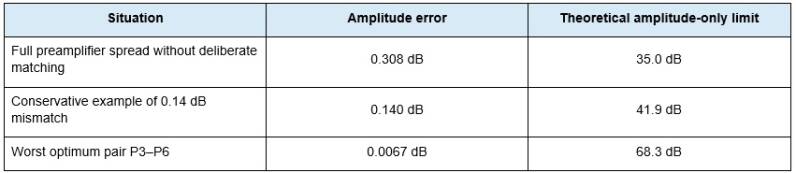
This shows why excellent preamplifier gain matching does not guarantee a real 60 or 70 dB null. A phase error of only 2° already limits ideal two-signal cancellation to about 35 dB. The RX9 also combines three active paths, making the complete situation more complex than this simple example.
7. Factors that remain after preamplifier matching
- electrical length and phase of the nine coaxial cables;
- amplitude and phase differences in the combiner and relay routes;
- differences in element impedance and actual antenna current;
- mutual coupling among the nine elements;
- soil conductivity, moisture and nearby objects around the array;
- arrival angle and polarisation of the wanted or interfering signal;
- preamplifier noise figure, linearity and broadband gain, which were not measured by this oscilloscope test;
- measurement resolution: the theoretical 68.3 dB derived from 0.0067 dB must not be interpreted as a guaranteed real null.
8. Practical final assessment
What has been achieved? The nine preamplifiers are not only individually healthy, but can also be allocated so that the electronic gain balance of the four opposite axes is effectively perfect. The worst recommended pair mismatch is only 0.0067 dB and the centre weighting differs from the outer mean by only 0.0042 dB.
What does this mean outdoors? The preamplifiers are not expected to add any noticeable asymmetry or limitation to a normally operating RX9 array. If the final rejection is, for example, 20 to 35 dB, the main limitation will probably lie elsewhere in the complete antenna chain or environment. The principal benefit of the matching is that subsequent alignment no longer needs to question whether one preamplifier is causing the difference.
Create Your Own Website With JouwWeb